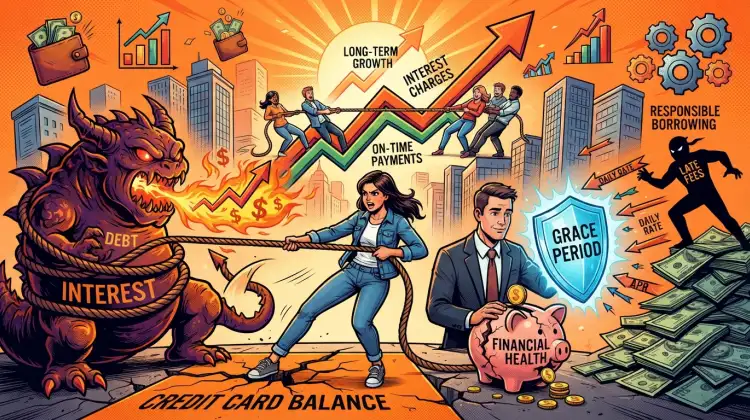
If you carry a balance on a credit card, the interest you pay can quietly become one of the largest costs in your household budget. Credit card interest explained clearly comes down to three things: your annual percentage rate (APR), how the issuer converts that APR into a daily rate, and whether you have a grace period. Understanding these mechanics is the difference between paying a few dollars a month and paying hundreds.
What APR Actually Means on a Credit Card
The APR is the yearly cost of borrowing, expressed as a percentage. According to the Federal Reserve, credit card APRs are variable, meaning they are tied to a benchmark index — most commonly the prime rate — plus a margin set by the issuer. When the Federal Reserve changes its target rate, your APR can move with it.
Most cards carry several APRs:
- Purchase APR — applies to new purchases you carry past the due date.
- Balance transfer APR — often a promotional 0% for a set period, then a higher standard rate.
- Cash advance APR — typically the highest rate, and usually with no grace period.
- Penalty APR — a higher rate that can apply after a late payment, though the CARD Act limits when issuers can impose it.
Your specific rate appears on every monthly statement, along with a table showing how long it would take to pay off your balance making only minimum payments.
How Issuers Calculate Your Daily Interest
Credit card interest is not applied once a year. Issuers divide your APR by 365 to get a daily periodic rate, then multiply that by your average daily balance and by the number of days in the billing cycle.
Example: a 24.99% APR becomes roughly 0.0685% per day. On a $3,000 average daily balance over a 30-day cycle, that is about $61.65 in interest for that month alone — roughly $740 a year if the balance never changes.
Two details matter here. First, issuers generally use the average daily balance, not your statement balance, so mid-cycle payments reduce interest slightly. Second, most issuers compound interest daily, which means unpaid interest is added to your balance and begins earning interest itself. That compounding is why balances can feel like they grow on their own.
The Grace Period: The Most Valuable Feature on Your Card
A grace period is the window between your statement closing date and your payment due date — typically at least 21 days under the Credit CARD Act of 2009. If you pay your statement balance in full by the due date, you owe no interest on purchases.
Here is the catch most people miss: if you carry a balance, you generally lose the grace period on new purchases until you pay the balance in full again. That means new purchases start accruing interest from the transaction date, not the statement date. Cash advances almost never get a grace period.
How to Reduce the Interest You Pay
There is no trick to avoiding credit card interest — only behavior and negotiation. Practical steps include:
- Pay the statement balance, not the minimum. Minimum payments are designed to stretch repayment over years.
- Pay early or split payments. Lowering your average daily balance reduces the interest charged that cycle.
- Ask for a lower APR. Issuers sometimes reduce rates for long-standing customers with clean payment histories; a single phone call is worth trying.
- Consider a 0% balance transfer. A promotional offer can pause interest, but watch the transfer fee (often 3%–5%) and the date the promo ends.
- Use a debt avalanche or snowball. Direct extra payments to the highest-APR balance first to minimize total interest.
- Avoid cash advances. They often carry a fee plus immediate interest at the highest rate on the card.
Interest, Credit Scores, and Long-Term Costs
Carrying high balances affects more than your wallet. Credit utilization — the share of your available credit you are using — is a major factor in credit scores, and balances above roughly 30% of your limit can weigh on your score. A lower score can raise the cost of auto loans, mortgages, and insurance in many states. Paying down revolving debt therefore improves both your monthly cash flow and your long-term borrowing costs.
What to Remember
Credit card interest is charged daily on your average balance, driven by an APR that can change with the prime rate. The grace period is your best defense: pay the statement balance in full and you owe nothing in interest. If you carry a balance, prioritize the highest APR, avoid cash advances, and treat promotional 0% offers as a deadline, not a permanent fix. Knowing these rules turns credit card interest from a mystery into a number you can manage.