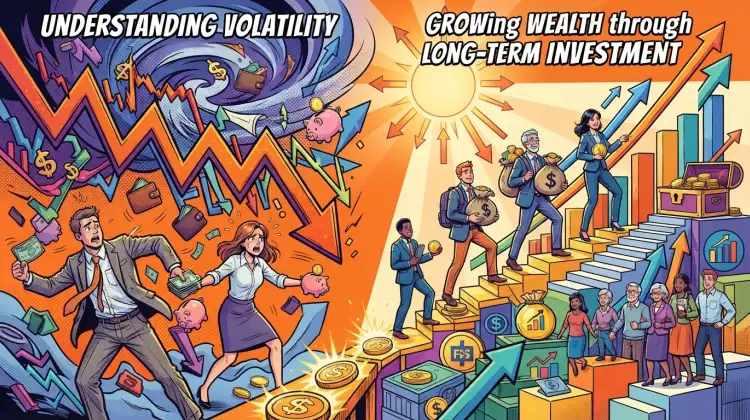
Stock market volatility is one of those terms that gets tossed around every time the Dow Jones Industrial Average or S&P 500 has a rough week. But volatility is not the same thing as loss, and understanding the difference is one of the most useful skills an everyday investor can build. In simple terms, volatility measures how much and how quickly prices move up and down over a period. A volatile market is one where prices swing widely; a calm market is one where they drift more gently. Neither condition tells you whether you will make or lose money over the long run — but both affect how you feel along the way.
This guide explains how volatility is measured, what drives it, and how long-term investors can respond without panicking or overtrading.
What Stock Market Volatility Actually Means
Volatility is a statistical measure of dispersion — how far returns deviate from their average. When people say the market is volatile, they usually mean daily price changes are large relative to normal. A 2% daily move in the S&P 500 is a big day; a 0.3% move is quiet. Volatility clusters: turbulent weeks tend to follow turbulent weeks, which is why markets can feel calm for months and then turn choppy for a stretch.
Importantly, volatility is directionless. A sharp rally is just as volatile as a sharp selloff. What investors fear is downside volatility, but the metric itself simply captures movement.
How Volatility Is Measured: Standard Deviation and the VIX
Two tools dominate the conversation:
- Standard deviation — the most common measure of how much an investment's returns vary around their average. A fund with a 15% annual standard deviation has historically seen yearly returns spread widely around its mean.
- The CBOE Volatility Index (VIX) — often called the market's "fear gauge." It reflects the 30-day implied volatility of S&P 500 index options. A VIX near 12–15 signals complacency; readings above 30 signal significant stress. The VIX spiked above 80 in March 2020 during the COVID-19 selloff.
Implied volatility is forward-looking — it reflects what options traders expect. Realized volatility is backward-looking — it measures what actually happened. Comparing the two helps explain why markets sometimes seem to price in more fear than materializes.
What Drives Market Volatility
Volatility rises when uncertainty rises. Common catalysts include:
- Economic data surprises — unexpected inflation readings, jobs reports, or Federal Reserve policy shifts.
- Earnings shocks — a major company missing guidance or a sector-wide disappointment.
- Geopolitical events — conflicts, trade disputes, or energy supply disruptions.
- Liquidity conditions — when buyers thin out, prices gap more easily.
- Sentiment and positioning — crowded trades unwind fast, amplifying moves.
Research from the Federal Reserve and academic finance has long shown that volatility is persistent and tends to rise more sharply than it falls — markets "take the stairs up and the elevator down."
Volatility vs. Risk: A Key Distinction
Many investors conflate volatility with risk. Volatility is short-term price movement; risk is the probability of permanent capital loss or failing to meet a financial goal. A diversified stock index fund can be highly volatile day to day yet historically has delivered positive long-run returns. Conversely, a "low-volatility" bond fund can still lose purchasing power to inflation.
For long-term investors, the real risk is often behavioral: selling during a drawdown and missing the recovery. Missing just a handful of the market's best days can meaningfully reduce long-term returns, according to widely cited research on market timing.
How Long-Term Investors Can Manage Volatility
You cannot eliminate volatility, but you can prepare for it:
- Match your asset allocation to your time horizon. Money you need in two years does not belong in stocks; money you will not touch for 20 years can tolerate more swings.
- Diversify across asset classes and sectors. Stocks, bonds, and cash respond differently to the same news.
- Automate contributions. Dollar-cost averaging through payroll or automatic transfers removes emotion from the decision.
- Rebalance periodically. Rebalancing forces you to trim winners and add to laggards — a disciplined response to volatility.
- Keep an emergency fund. Cash reserves prevent forced selling during downturns.
- Write down your plan. A simple investment policy statement makes it easier to stay the course when headlines turn scary.
What to Remember About Volatility
Volatility is a normal, unavoidable feature of investing in stocks — not a malfunction. It is measured by standard deviation and the VIX, driven by uncertainty, and distinct from the risk of permanent loss. The most effective response for everyday investors is not to predict swings but to build a diversified, appropriately allocated portfolio and stick with it through the noise. If volatility is keeping you up at night, your allocation is telling you something — adjust it before the next storm, not during it.