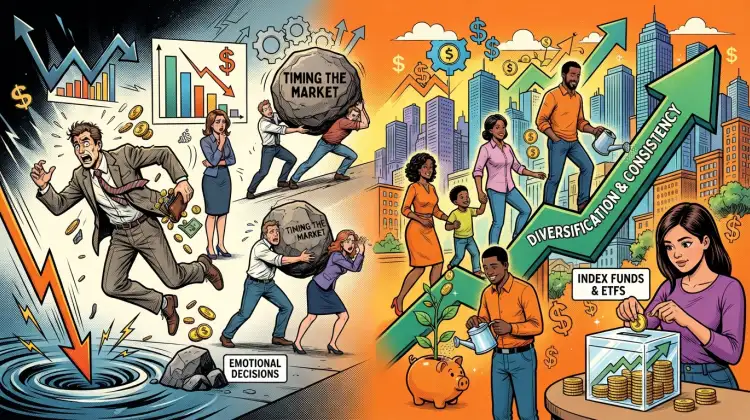
The biggest determinant of investment success is rarely which fund you pick. More often, it is whether you can stay invested through the uncomfortable stretches. A long term investing mindset is the set of beliefs and habits that lets you hold a diversified portfolio through volatility, ignore short-term headlines, and let compounding do the heavy lifting. This article explains what that mindset looks like in practice, why the evidence supports it, and how to build it for yourself.
Why Time in the Market Beats Timing the Market
Markets reward patience because equities compensate investors for uncertainty. Missing just a handful of the best trading days can meaningfully reduce long-run returns. Research from J.P. Morgan Asset Management has repeatedly shown that an investor who missed the 10 best days in the market over a 20-year period ended with roughly half the ending balance of one who stayed fully invested. Because those best days tend to cluster near the worst ones, trying to dodge declines often means missing the recovery.
The practical takeaway is not that you should never sell. It is that reacting to short-term news is a costly habit. A long term mindset treats market drops as a normal cost of earning higher expected returns, not as evidence that the plan is broken.
The Core Beliefs of a Long Term Investor
Investors who succeed over decades tend to share a recognizable set of assumptions:
- Compounding is the engine. A 7% average annual return roughly doubles money every decade. Small differences in fees and behavior compound just as powerfully as returns do.
- Volatility is not the same as risk. The permanent risk is selling at the wrong time or holding an undiversified portfolio. Short-term price swings are the price of admission.
- You cannot predict, but you can prepare. No one consistently forecasts recessions or market tops. You can control asset allocation, savings rate, costs, and behavior.
- Your time horizon defines your strategy. Money you need in two years belongs in cash or short-term Treasuries, not stocks. Money you need in 20 years can tolerate far more volatility.
Building the Mindset: Practical Habits
Automate contributions
Set up automatic contributions to your 401(k) and IRA on a schedule you can sustain. Automatic investing removes the temptation to wait for a better entry point and enforces dollar-cost averaging without requiring discipline in the moment.
Write an investment policy statement
A one-page document stating your goals, target allocation, rebalancing rules, and what you will do during a 20% decline gives you a pre-commitment device. When markets fall, you follow the plan instead of improvising under stress.
Check your portfolio less often
Frequent portfolio checks increase the chance you see losses and feel compelled to act. Many long term investors review holdings quarterly or annually and ignore daily movements entirely.
Keep costs and taxes low
Broad, low-cost index funds such as those tracking the S&P 500 or total market have expense ratios well under 0.10% at major providers. Holding investments for more than a year also qualifies for lower long-term capital gains rates, which reinforces the case for patience.
Managing Emotions When Markets Fall
Behavioral finance research, including work cited by the CFA Institute, shows investors feel losses roughly twice as intensely as equivalent gains. That asymmetry drives panic selling. A long term mindset counters it with three tools: a written plan, an emergency fund so you never sell investments to cover expenses, and a clear understanding that a decline in account value is not a realized loss unless you sell.
It also helps to reframe downturns. If you are still contributing, a falling market means your regular purchases buy more shares. Younger investors in particular should view volatility as an opportunity rather than a threat.
Mistakes That Undermine Long Term Results
- Chasing recent winners after a strong run, which often means buying at elevated valuations.
- Abandoning a diversified portfolio for concentrated bets on a single stock or sector.
- Selling during declines and waiting for clarity that never arrives.
- Ignoring fees, which can consume a large share of returns over 30 years.
- Letting lifestyle inflation outpace savings rate increases.
What to Remember
A long term investing mindset is less about predicting markets and more about controlling what you can: your savings rate, your costs, your diversification, and your reactions. Build a written plan, automate contributions, keep an emergency fund, and review your portfolio infrequently. The investors who build wealth over decades are usually not the ones who trade the most, but the ones who stay invested through the noise.