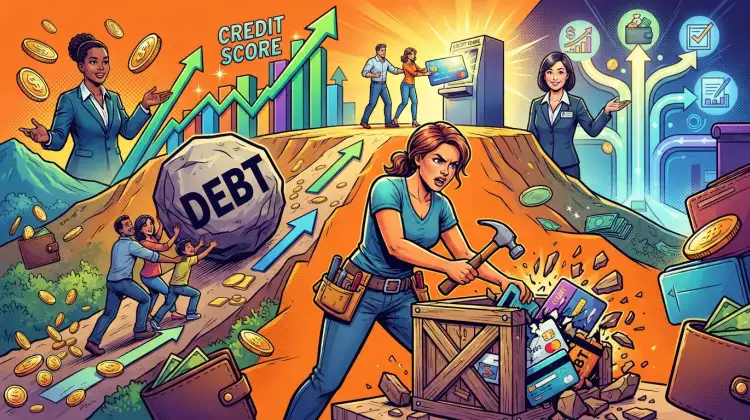
Paying off credit card debt is one of the highest-return financial moves you can make. Because credit card interest rates are typically far higher than what you'd earn in a savings account or pay on a mortgage, every dollar of principal you eliminate delivers a guaranteed return equal to your card's APR. The Federal Reserve's most recent data shows average credit card APRs hovering above 20% for accounts assessed interest, which means a $5,000 balance can cost well over $1,000 a year in interest alone if left unpaid. The good news: there are well-tested strategies that work, and they don't require a windfall.
First, Take an Honest Inventory of What You Owe
You can't build a payoff plan without knowing the full picture. Pull your credit reports from AnnualCreditReport.com — the only federally authorized source for free weekly reports from all three nationwide bureaus (Equifax, Experian, and TransUnion). Then list every card with its balance, interest rate (APR), minimum payment, and due date.
- Total balance: The sum you need to retire.
- APRs: Rank cards from highest to lowest — this drives most payoff strategies.
- Minimum payments: Note them, but understand that paying only the minimum on a high-APR card can keep you in debt for years.
- Credit utilization: Your balances relative to credit limits affect your credit scores, so lowering them helps on two fronts.
Choose a Payoff Strategy: Avalanche vs. Snowball
Both methods direct every spare dollar toward one card at a time while you make minimums on the rest. They differ in which card gets the extra money.
The debt avalanche
Put extra money toward the card with the highest APR first. Mathematically, this saves the most interest and gets you debt-free fastest. If you have a 27% store card and a 19% general-purpose card, the avalanche attacks the 27% card first.
The debt snowball
Put extra money toward the smallest balance first, regardless of rate. You'll pay somewhat more interest, but quick wins can sustain motivation. Research on consumer behavior has found that closing accounts one by one keeps people engaged with repayment.
There's no universally correct choice. If you're disciplined, the avalanche usually wins on cost. If you've stalled out before, the snowball's momentum may be worth the modest extra interest.
Lower Your Interest Rate Where You Can
Reducing the APR accelerates every strategy above. Consider these options:
- Ask for a rate reduction. Call the issuer, reference your on-time payment history, and request a lower APR. Success isn't guaranteed, but it costs only a phone call.
- Balance transfer cards. A 0% intro APR balance transfer card can pause interest for 12–21 months, but watch the balance transfer fee (typically 3%–5%) and the go-to APR that applies afterward. You generally need good-to-excellent credit to qualify.
- Debt consolidation loans. A personal loan with a fixed rate can replace revolving balances with a predictable payment. Compare the loan APR against your weighted average card APR — and beware of extending repayment so long that total interest rises.
- Hardship programs. If you're struggling, issuers sometimes offer reduced-rate or hardship plans. Ask specifically about them.
Build a Payment Plan You Can Actually Sustain
Set a target payoff date and work backward. If you owe $6,000 at 22% APR, paying about $300 a month clears the balance in roughly two years; paying $150 stretches it past five years and roughly doubles the interest. Automate the payment for the day after your paycheck so it happens before discretionary spending. Route windfalls — tax refunds, bonuses, side income — straight to the target card.
If your budget can't cover minimums, contact a nonprofit credit counseling agency affiliated with the National Foundation for Credit Counseling (NFCC). A debt management plan can consolidate payments and negotiate lower rates, typically for a modest monthly fee. Avoid for-profit "debt relief" companies that charge large upfront fees or tell you to stop paying creditors.
Protect Your Credit Along the Way
Keep accounts open and in good standing while you pay them down — closing cards raises your utilization ratio and can ding your scores. Pay at least the minimum on every account every month; a single 30-day late payment can stay on your reports for seven years. As balances fall, your credit utilization drops, which is one of the most influential factors in credit scoring models, so your scores often improve as you make progress.
What to Remember
Paying off credit card debt rewards you twice: you stop paying 20%-plus interest and you free up cash flow for savings and goals. Start with a full inventory, pick the avalanche or snowball method, push your APRs down through negotiation or a balance transfer, and automate payments so consistency doesn't depend on willpower. If minimums feel unmanageable, a nonprofit NFCC counselor can help you build a plan before missed payments damage your credit.